
The Statement of Needs
One of the most unusual communications projects I have worked on began with a vacancy.
When the Bishop of Liverpool stepped down, the diocese entered a period of uncertainty. There was no obvious successor, no clear timeline and no definitive answer to the question many people were asking: what happens next?
Part of the formal appointment process required the production of a Statement of Needs, a document designed to help shape the search for the next bishop. On paper, it sounds like a governance exercise. A requirement. A process to be completed.
In reality, it became something much more interesting.
The Diocese of Liverpool is not a single community. It is hundreds of churches, schools, clergy, congregations, volunteers, staff and stakeholders spread across a diverse region. It contains different traditions, different priorities and different hopes for the future. The challenge was never going to be writing the document itself. The challenge was understanding what the document needed to say.
The process began with a simple question: how do you genuinely listen to an entire diocese?
Over several months we undertook one of the most significant listening exercises in recent diocesan history. Hundreds of adults participated through surveys, consultations and engagement events, alongside hundreds of contributions from children and young people. People spoke honestly about their hopes, frustrations, concerns and ambitions. Some wanted stability. Others wanted change. Some talked about parish ministry, while others focused on growth, leadership, mission or engagement with wider society.
As the responses began to emerge, it became clear that the challenge was not finding a single vision. There wasn’t one.
What existed instead was a collection of perspectives that were sometimes complementary, sometimes contradictory and often deeply personal.
That is where communications became important.
There is always a temptation when producing organisational documents to smooth out complexity. To remove disagreement. To create a neat narrative that feels coherent and reassuring. Yet doing so would have missed the point entirely.
The most honest reflection of the Diocese of Liverpool was not a document that claimed everybody agreed. It was a document that acknowledged both the diversity of views and the shared desire to move forward together.
What emerged was a Statement of Needs that attempted to tell the truth about where the diocese found itself. It celebrated strengths and opportunities whilst also recognising challenges around clergy wellbeing, finance, mission and the changing nature of communities. It reflected a diocese that was hopeful, ambitious and committed to its future, but also realistic about the work required to get there.
Looking back, the project reinforced something I have come to believe about communications.
We often associate communications with speaking. The reality is that some of the most important communications work happens when organisations choose to listen.
Listening sounds simple, but it rarely is. It creates expectations. It surfaces disagreement. It introduces complexity. It forces organisations to confront perspectives they may not have considered before.
Yet organisations that fail to listen often find themselves making decisions based on assumptions rather than understanding.
At the time, nobody knew who the next Bishop of Liverpool would be. That uncertainty was unavoidable. What mattered was ensuring people felt they had been given an opportunity to contribute to the conversation and shape what came next.
For me, that was the real value of the Statement of Needs.
Not that it helped appoint a bishop, important though that was.
It helped a diocese pause, listen and articulate who it was, what it valued and what it hoped to become.
In an age where organisations are often rushing to provide answers, there is something powerful about taking the time to ask better questions.
When I first started talking about influencer marketing at Liverpool Cathedral, I knew exactly what some people would be thinking.
At face value, it sounds like an odd combination. Influencer marketing feels perfectly at home in fashion, hospitality and consumer brands. Cathedrals belong to a different world. They are places of worship, heritage, tradition and community. They are institutions that have existed for centuries. Social media influencers, by contrast, often feel like a distinctly modern phenomenon.
Yet the more I thought about it, the more I became convinced we were asking the wrong question.
The question was not whether influencer marketing belonged in a cathedral.
The question was whether cathedrals were prepared to communicate in the way people increasingly consume information.
For generations, institutions have largely controlled their own narratives. If you wanted to learn about an organisation, you visited its building, read its publications or consumed coverage through traditional media. Today, people discover places through recommendations, creators and social media content. Trust increasingly sits with individuals as much as institutions.
The reality was that people were already creating content about Liverpool Cathedral. Every day visitors photographed the building, filmed videos, shared experiences and recommended us to friends and followers. Conversations about the cathedral were already happening online whether we chose to participate in them or not.
What interested me was whether we could become part of that conversation in a way that felt authentic to who we were.
That authenticity mattered.
The easiest mistake would have been to treat the cathedral as a backdrop. To see influencer marketing simply as another promotional channel. That approach would have felt hollow and, ultimately, unsuccessful.
Instead, we focused on creators who were genuinely interested in the building, its story and its role within the city. We invited people to experience the cathedral for themselves and trusted them to tell that story in their own voice.
That required a degree of organisational confidence.
Institutions are often most comfortable when they control every word. Influencer marketing demands something different. It requires trust. Trust that people will interpret an organisation honestly. Trust that audiences can make up their own minds. Trust that authenticity will achieve more than a carefully scripted message.
For an institution built long before the invention of social media, that represented a significant cultural shift.
The results were encouraging. We reached audiences who would never have engaged with a traditional press release or marketing campaign. We connected with people who had never visited the cathedral and, in some cases, had never considered doing so. More importantly, we found that people responded positively when they encountered the cathedral through the experience of others rather than through institutional messaging alone.
Looking back, the project taught me something broader about communications.
Many organisations assume the challenge is keeping up with new channels and technologies. In my experience, the real challenge is adapting to changing audience expectations without losing sight of who you are.
The success of influencer marketing at Liverpool Cathedral was not that we started behaving like a modern consumer brand.
It was that we remained unmistakably a cathedral whilst finding new ways to tell our story.
That balance between tradition and innovation is something many organisations wrestle with. The temptation is often to choose one or the other. Yet the most successful institutions are usually those that understand how to honour their history whilst remaining relevant to the people they serve today.
@girlssonthego The Light Before Christmas show is back on the 28th of November ⭐️⭐️ tag someone you want to go with this November #liverpool ♬ original sound – via
Leading communications across Liverpool Cathedral and the Diocese of Liverpool presents a unique challenge.
Although closely connected, they are ultimately two separate organisations with distinct priorities, audiences, leadership structures and objectives. The cathedral is a major place of worship, visitor attraction and cultural institution. The diocese supports hundreds of churches, clergy and communities across the Liverpool City Region and beyond.
Both organisations generate a constant flow of activity. Both have important stories to tell. Both believe, quite rightly, that their work deserves communications support.
The challenge is that there is only one communications function serving them both.
As the volume and complexity of work increased, I began to recognise a growing problem. Communications decisions were often being driven by immediacy rather than strategic importance. Urgent requests competed with long-term priorities. Significant organisational initiatives sat alongside routine activity. Every department, team and project had a valid case for why their work mattered.
The result was a challenge familiar to many communications teams.
When everything is a priority, nothing is.
What was needed was not more activity, but a better way of making decisions.
The solution was a tiered communications framework.
Rather than starting with channels and outputs, the framework encouraged colleagues to think first about impact. What organisational objective does this support? Who needs to hear it? What are the reputational implications? What level of communications resource is genuinely required?
The framework categorised activity into three levels.
Tier 1 projects represented major organisational priorities requiring a fully integrated communications approach. These included significant campaigns, major organisational announcements, high-profile events, reputation-sensitive issues and activity that required coordination across multiple channels and audiences.
Tier 2 projects required planned communications support but at a lower level of complexity and resource. These projects remained important, but did not require the same degree of strategic focus as Tier 1 activity.
Tier 3 activity covered routine communications requests delivered through established channels and processes without the need for a dedicated campaign approach.
The simplicity was deliberate. The framework needed to be understood not just by communications professionals, but by senior leaders, project teams and colleagues across both organisations. Its success depended less on the framework itself and more on creating a shared understanding of how communications decisions were made.
The aim was not to create a hierarchy of importance. Every piece of work mattered to somebody. The purpose was to ensure that finite communications resource was aligned with organisational priorities rather than simply reacting to whichever request arrived first.
Introducing the framework required more than a change in process. It required organisational buy-in. Senior leaders across both the cathedral and diocese needed confidence that the system was fair, transparent and capable of supporting their priorities. Conversations that had previously focused on outputs began to focus on outcomes.
Instead of being asked, “Can you put this on social media?” we increasingly found ourselves discussing questions such as, “What are we trying to achieve?”, “Who needs to hear this?” and “Why does this matter?”
Communications moved from being viewed primarily as a delivery function to becoming part of wider organisational decision-making. The framework created space for strategic conversations and helped ensure that communications resource was directed towards the initiatives that would have the greatest organisational impact.
Looking back, the framework solved a practical problem, but it also reinforced something I have come to believe about communications leadership.
Most communications challenges are not actually communications challenges.
- They are prioritisation challenges.
- They are clarity challenges.
- They are leadership challenges.
The role of communications leaders is not simply to create content or manage channels. It is to help organisations make informed decisions about what matters, what does not and where limited attention should be focused.
Sometimes the most important communications work is not telling a story. It is deciding which stories need to be told in the first place.

How do you display the works of one of the most influential artists of our time in one of the most culturally significant places of worship? More importantly, how do you market something so open for interpretation and tell the story of its journey to an audience defined by diversity?
In 2024, Liverpool Cathedral welcomed Monadic Singularity, an exhibition by Anish Kapoor. Over the course of five weeks almost 80,000 people visited the cathedral, generating an estimated £3.8 million in economic impact for the city region. Those are impressive numbers, but they are not what I remember most about the project. What stays with me is the communications challenge that sat behind it.
How do you communicate a single exhibition to an audience that isn’t really one audience at all?
Some visitors arrived because they were followers of Anish Kapoor’s work. Others came because they were tourists visiting Liverpool. Some were regular worshippers at the cathedral. Others had never set foot in a church before. Alongside them were civic leaders interested in economic impact, arts organisations interested in cultural significance, journalists interested in controversy and families simply looking for something interesting to do on a Saturday afternoon.
Communications theory would suggest segmenting those audiences and tailoring messages for each group. There is some truth in that. But I think there is a danger in believing that every audience requires a different story.
What Monadic Singularity taught me is that sometimes the challenge is not to tell different stories, but to tell one story well enough that different people can find their own way into it.
The temptation would have been to over-explain the exhibition. To tell visitors what it meant. To define its relevance to a cathedral. To provide a carefully crafted interpretation of every piece. Instead, we took almost the opposite approach.
We allowed the artwork to speak within the space that housed it.
The exhibition existed within a living cathedral rather than a traditional gallery. Services continued around the artwork. Visitors encountered prayer, worship and reflection alongside contemporary art. One of the most striking pieces was positioned within the altar space itself, creating a literal reflection between the artwork, the building and the faith that has shaped the cathedral for over a century.
Where interpretation was needed, we provided it. Information boards explored theological themes and connections. Press materials focused on the significance of Kapoor’s first exhibition within a cathedral setting. Media interviews explored the relationship between creativity, faith and public life. But we resisted the urge to force a single narrative onto the visitor experience.
That mattered because different people arrived looking for different things. An art student could engage with questions of form, scale and meaning. A worshipper might see something spiritual. A tourist might simply enjoy encountering something unexpected in one of Liverpool’s most recognisable buildings. None of those interpretations were wrong. In many ways, the success of the exhibition depended on creating space for all of them.
Looking back, I think the project reinforced something I have come to believe about communications more broadly. We spend a great deal of time talking about messages. Organisations become obsessed with finding exactly the right words. Yet people rarely connect with messages first. They connect with stories, experiences and authenticity.
We were not pretending to be an art gallery. We were not pretending to be a visitor attraction. We were not pretending to be anything other than a cathedral. Our role was to explain why a cathedral would choose to host an exhibition like this and why we believed those conversations were worth having.
The results were significant. Visitors travelled from across the United Kingdom and around the world. The exhibition generated substantial economic benefit for the city region and attracted national attention. Yet the statistics only tell part of the story.
What I remember are the conversations.
The worshipper discussing contemporary art over coffee after a service. The family trying to work out what a piece meant. The visitor who arrived curious about Kapoor and left curious about the cathedral itself.
For me, that was the real success of Monadic Singularity. Not that it gave people answers, but that it encouraged them to ask questions. The best communications campaigns do exactly the same thing.
PRESS AND MEDIA
FAD Magazine
ArtNet News
ChurchTimes
The Guardian
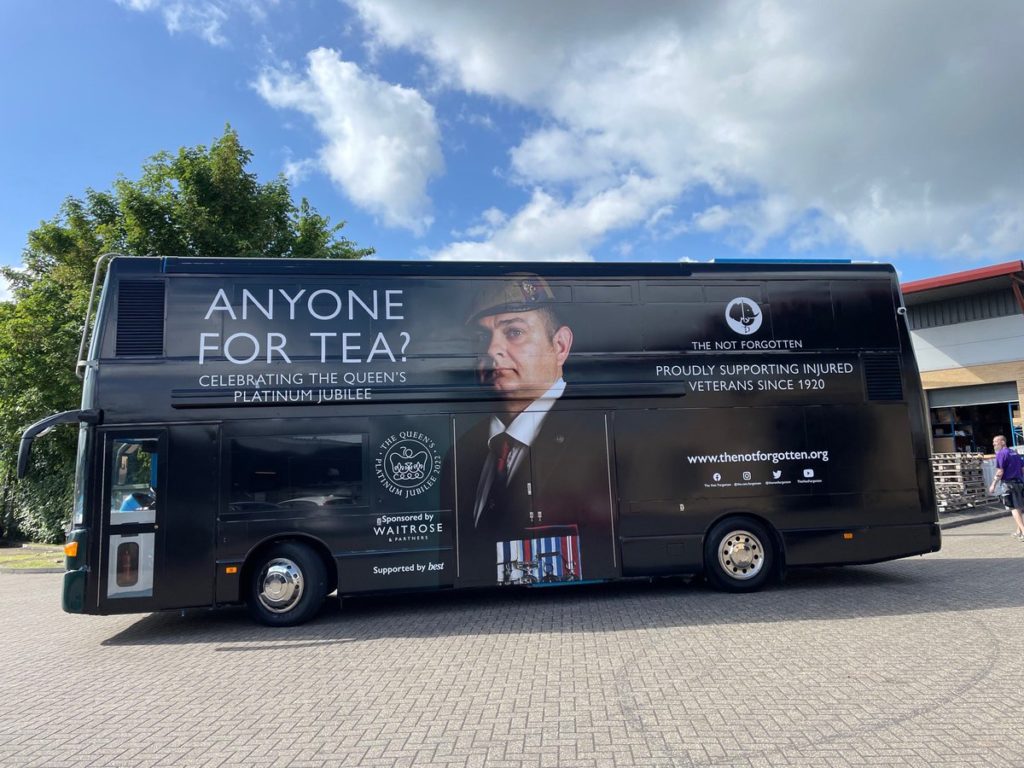
Anyone for Tea?
One of the most successful campaigns I worked on involved a double-decker bus, afternoon tea and a charity approaching its centenary.
On paper, it sounds delightfully eccentric.
In reality, it taught me one of the most important lessons I’ve learned about communications.
The campaign was called Anyone for Tea? and was developed during my time at The Not Forgotten, a charity supporting veterans and serving personnel across the UK. As we approached a significant anniversary, the challenge was a familiar one.
How do you celebrate a long history without simply talking about the past?
Many organisations respond to milestones by producing commemorative books, anniversary logos and nostalgic social media campaigns. There is nothing wrong with any of those things. But they often leave an organisation looking backwards when it should also be thinking about where it is going next.
The answer came from the charity’s origins.
When The Not Forgotten was founded, its mission was remarkably simple. Our founder would visit isolated and forgotten servicemen in hospitals, bringing companionship, entertainment and, often, a cup of tea. What began as a small act of kindness eventually grew into a national charity under the patronage of HRH The Princess Royal.
The more we explored that history, the more we realised the anniversary was not really about celebrating age.
It was about reconnecting with purpose.
So instead of asking people to come to us, we decided to take the charity back on the road.
We wrapped a double-decker bus in the charity’s branding and, sponsored through a partnership with Waitrose, embarked on a national tour, travelling across the country to meet veterans where they were. Along the way we served afternoon tea, provided entertainment, welcomed celebrity guests and created opportunities for veterans to reconnect with one another and with the charity itself.
The logistics were substantial. The communications challenge was even greater.
How do you tell a story that resonates with veterans, families, supporters, funders, local communities and national media at the same time?
The answer was not to focus on the bus.
The answer was to focus on what the bus represented.
Every stop on the tour became an opportunity to tell the story of the charity’s founding mission. Every cup of tea became a reminder that, despite decades of growth and change, the organisation remained rooted in the same idea that inspired its creation.
The campaign generated media coverage, attracted high-profile support and helped raise awareness of the charity’s work. But what stayed with me was something else entirely.
People rarely connect with organisations because of what they do.
They connect because of why they do it.
The bus was memorable. The celebrity appearances were valuable. The anniversary itself created interest.
But none of those things would have mattered without a story that people could believe in.
Looking back, Anyone for Tea? reinforced something I have seen repeatedly throughout my career.
The strongest organisational stories are rarely invented, they are uncovered.
Often the most powerful communications strategy is not creating a new narrative at all. It is rediscovering the one that was there from the beginning and finding a way to tell it to a new generation.
That is what the tour achieved.
Not a celebration of history for its own sake, but a reminder that the best organisations never lose sight of why they exist.
PRESS AND MEDIA
COBSEO
BANBURY GUARDIAN
PORTSMOUTH, THE NEWS
Long before I became a Head of Communications, I was a blogger.
In truth, I didn’t think of myself as a blogger at the time. I was simply writing. Writing to understand myself. Writing to make sense of adoption, identity, mental health and some of the questions that seemed to occupy more space in my head than I knew what to do with.
When I published my first posts in 2015, I assumed very few people would ever read them. The internet felt vast and anonymous. My little corner of it felt insignificant. There was no strategy behind it, no audience development plan and certainly no ambition to turn it into a career. If anything, the writing was for me.
What surprised me was how quickly it stopped being just for me.
People started reading. Then they started commenting. Then they started emailing. Some agreed with what I had written. Others challenged it. Many shared stories of their own. What began as a personal project slowly became something else entirely.
Looking back, I think what people responded to was not necessarily the subject matter. Most readers weren’t adopted. Many had never experienced the specific situations I was describing. Yet underneath the details sat something more universal. Questions about belonging. Identity. Family. Mental health. The feeling of trying to understand who you are and where you fit in the world.
The audience grew steadily over the following years and with it came opportunities I could never have anticipated. There were speaking engagements, interviews and invitations to contribute to wider conversations about mental health. In 2019, I was named Mental Health Writer of the Year at the UK Blog Awards.
At the time, it felt like a milestone. Looking back, I think it represented something more important.
The award arrived after years of writing, but the real value of those years had very little to do with recognition. They taught me lessons that I still draw on every day.
One of those lessons was that people have an extraordinary ability to recognise authenticity. The articles that resonated most were rarely the ones I spent the longest writing. They were usually the ones where I stopped trying to sound clever and started trying to be honest. The pieces where I admitted uncertainty, explored difficult emotions or shared experiences I had not fully figured out yet often generated the strongest response.
That was not what I expected.
Like many people, I assumed communication was largely about having answers. What I discovered was that people often connect more deeply with questions.
The other lesson was that communication is not really about transmitting information. It is about creating connection.
The comments beneath articles taught me that. So did the emails from strangers. Again and again, people would write not to discuss the details of my story, but because something in it had reminded them of their own. The best communication creates that moment of recognition. It allows people to feel understood, even if only briefly.
I did not realise it at the time, but those experiences were shaping the way I would approach communications for the rest of my career.
Years later, whether I am helping a cathedral tell its story, supporting an organisation through a period of change or navigating a communications crisis, I find myself returning to many of the same principles. Audiences are not won over by polished messaging alone. Trust is not built through perfectly crafted campaigns. People respond when they feel they are being spoken to honestly and treated with respect.
Perhaps the most important thing the blog taught me was that audiences are not something you build. They are something you earn.
Trust arrives slowly. It is built through consistency, honesty and showing up over time. Every interaction either strengthens that relationship or weakens it. The same is true whether you are writing a blog post for a handful of readers or communicating on behalf of an institution serving hundreds of thousands of people.
The award itself sits in a box somewhere.
The lessons have stayed with me.
Looking back now, I can see that the blog was never really about mental health, adoption or even writing. It was my first lesson in communication. More specifically, it was my first lesson in trust.
Everything I have done since has been an attempt to apply that lesson on a larger scale.